
Running Ads to Your Homepage vs. a Dedicated Landing Page
A homeowner is scrolling after dinner and your ad stops them: a paver patio, a real price context, a finished project that looks like their backyard could. They tap. What happens in the next five seconds decides whether that tap becomes a quote request or just another click you paid for.
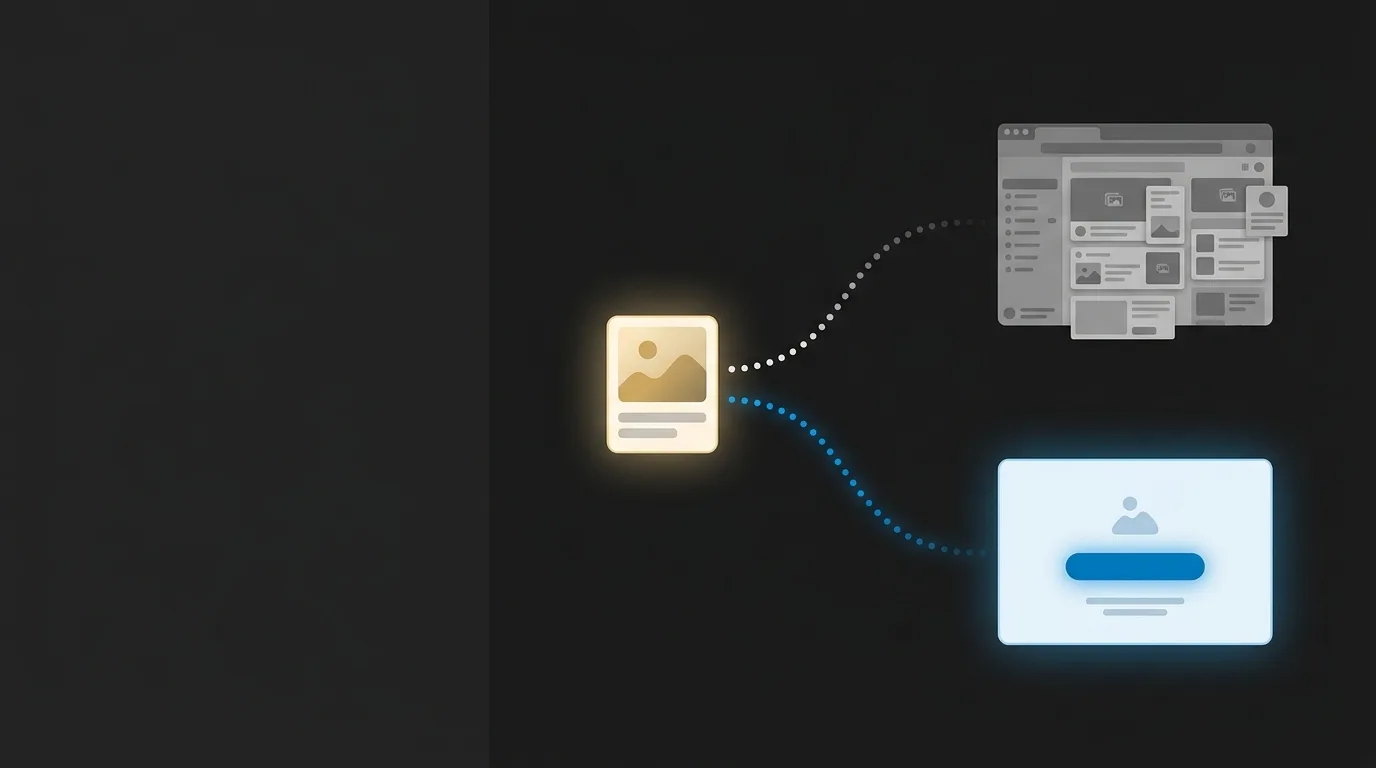
If the tap lands on your homepage, the next five seconds are spent orienting. If it lands on a page built for that exact ad, the next five seconds are spent reading about the thing they already wanted. That difference sounds small, and it compounds across every dollar of your ad budget.
This is the argument for dedicated landing pages, laid out plainly, with the numbers we actually watch and an honest note about when your regular website is the right destination after all.
What actually happens when an ad click lands on your homepage
Your homepage was built to speak to everyone, and that is exactly the problem. It opens with a slider or a broad headline, lists every service you offer, and gives the visitor a navigation menu with somewhere between six and a dozen places to go. For someone who typed your name into Google on a neighbor's recommendation, that is fine. They came to browse you.
An ad click is a different visitor. They did not come to browse, they came because one specific promise interrupted their evening, and now they have to find that promise again inside a site that is busy saying everything else. Some of them will click into your services menu and dig. Most will not. They close the tab, and the platform charges you the same either way.
There is a second, quieter cost: mismatch. The ad said one thing in one tone, and the homepage says something broader in another. Even when the visitor stays, the page spends its first moments re-earning attention the ad had already won.
What a dedicated landing page does differently
A dedicated landing page is built backward from one ad and one offer. It opens with the exact thing the click promised, in the same language the ad used, so there is no re-orienting and no hunt. The proof on the page, photos, results, reviews, belongs to that one job type instead of your whole company history.
Then it does the thing a homepage almost never does: it offers exactly one next step. No menu, no six other services, no blog. A form or a phone number, and a reason to use it now. The form itself works harder too, because it can ask the questions that matter for that specific project, which is how budget qualification happens at the source instead of in your sales team's wasted appointments.
None of this makes the landing page prettier than your website. It makes it narrower, and narrower is the point. A page trying to convert one visitor with one intent beats a page trying to be everything to everyone, every time we have measured it.
The numbers behind the argument
Two figures from our own client work show the size of the difference. Probuilt Pool & Patio's split-tested landing pages convert at 6% or better, and that conversion engine sat underneath a year in which about $28,000 in Meta ad spend returned $400,000 and more in direct revenue, a 16:1 return on media spend for calendar year 2025, Meta only. The landing pages are not a side detail of that result. They are the mechanism that turned paid clicks into booked estimates all year.
On our best-performing landing pages, 1 in 3 leads makes it to the quote stage. That is not a site-wide average, and it is not a promise for every campaign we run. It is what a page built around one offer, with qualification built into the form, can do when the ad and the page tell one story.
Results vary by client, market, and offer, and none of these figures are a guarantee. They are the reason the click never goes to the homepage when we run ads.
When sending traffic to your website is fine
Honesty requires the other half of the answer. If someone searches your company by name, your website is the right destination, because that visitor came to evaluate you, and the full site is the evaluation. The same goes for a homeowner arriving from a review, a referral, or an AI recommendation: breadth is what they want.
The rule we run is narrower than "landing pages always win." It is: cold, paid traffic goes to a page built for the ad that earned it. Warm traffic that already knows your name can have the whole site. Your website and your landing pages are not competing for the same job, and a serious marketing setup needs both doing the job each was built for.
Where your ad click lands is not a detail of the campaign. It is a buildable decision, and it deserves a page built for it.
See how we build sites and landing pages that convert- An ad click is a different visitor from a homepage visitor: they came for one promise, and every extra choice on the page works against the sale.
- A dedicated landing page opens with the exact offer the ad made, carries proof for that one job type, and gives a single next step.
- Probuilt Pool & Patio's split-tested landing pages convert at 6% or better, part of a 16:1 media-only return on about $28,000 of Meta spend in calendar year 2025. Results vary by engagement.
- On our best-performing landing pages, 1 in 3 leads reaches the quote stage. That figure is scoped to those pages, not a site-wide average or a promise.
- Branded and referral traffic still belongs on your website. The rule is about cold, paid traffic, not everything.
Want your next ad click to land somewhere built to convert it?
Related articles
Further readingWhy Your Facebook Leads Don't Answer the Phone
The autofill mechanism behind dead leads, and why qualification has to happen at the source.
Read nextWhat Contractors Actually Pay for Leads
Real cost ranges by channel, and why the cheapest lead is rarely the cheapest job.
Read nextExclusive Leads vs. Shared Leads
What shared-lead platforms actually sell you, and what exclusivity changes.
Read next